Reconstructing an Art Deco Masterwork: Bringing a Rene Paul Chambellan Sketch to Life
In early 2025, I received one of the most extraordinary gifts imaginable for anyone passionate about American Art Deco sculpture: access to the private sketchbooks and archival materials of Rene Paul Chambellan, courtesy of his grandson Tony. Among the folders he shared was a series of working pencil studies—raw, spontaneous marks that reveal the sculptor’s hand at its most intimate and exploratory.
One sketch in particular stopped me cold.
It was a partially finished figure—dynamic, angular, unmistakably Chambellan—yet incomplete. Whole areas of the composition trailed off into faint guide lines, or ended abruptly where he seemed to have intended to return later.
This was not a finished artwork.
It was a moment—a glimpse into the sculptor’s thinking.
And it was calling out to be completed.
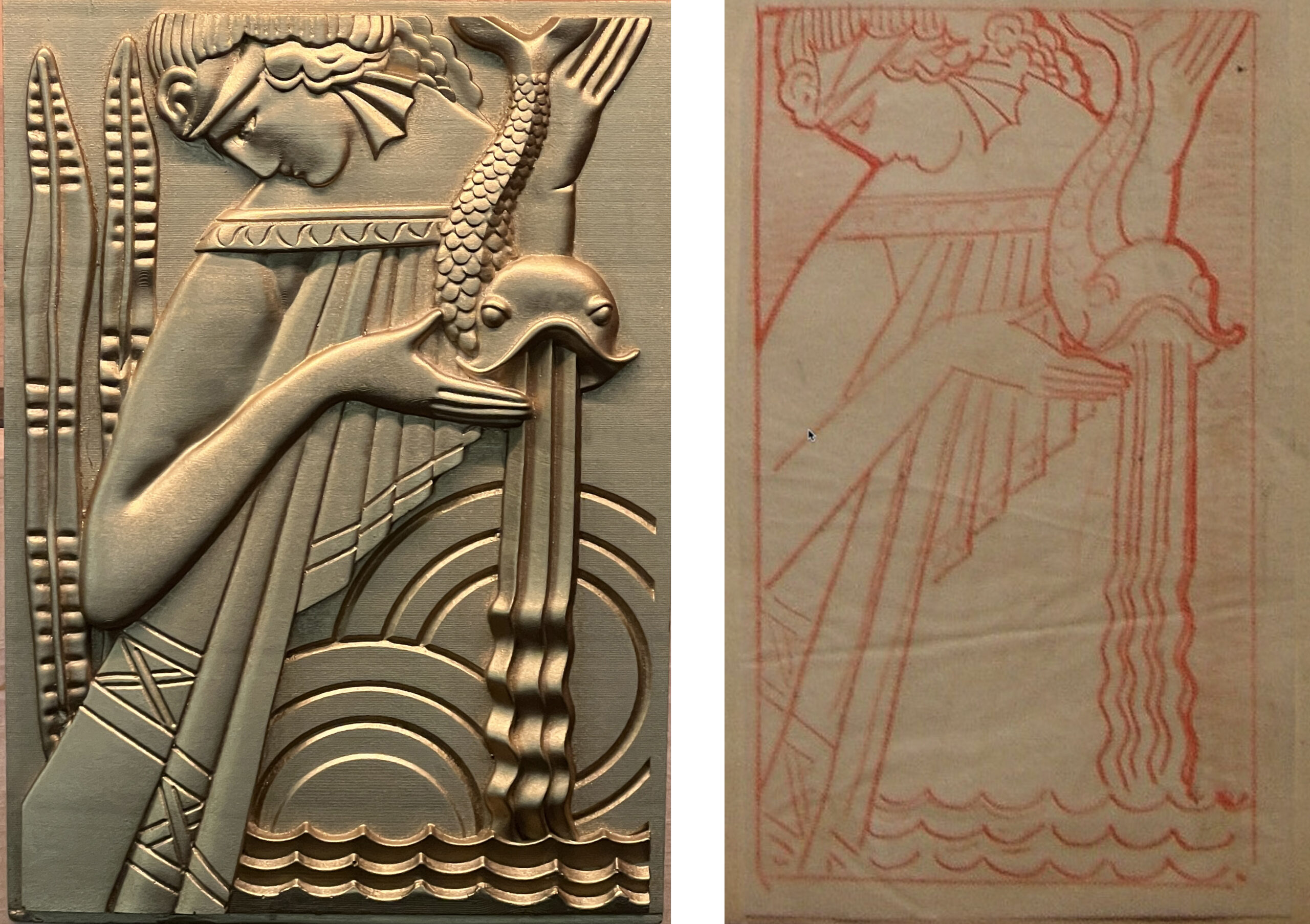
The result of that journey is the plaque I titled “Woman of the Sea,” a contemporary work created in the Chambellan style while honoring the integrity of the original 1930s pencil study.
You can see the finished piece here:
View This Art-Deco Piece on Etsy
Explore the finished plaque inspired by the original Chambellan sketch. Click below to view the listing in my Etsy shop.
View Listing on Etsy →This post is the story of how it came to be.

The Sketch: A Conversation Across Time
The original sketch—reproduced here in low resolution with permission from the Chambellan Family Archive—shows a fluid female figure emerging from or surrounded by forms that suggest waves, fabric, or carved shell-like planes.
Some elements were precise and characteristically Chambellan:
- The sweeping arc of the torso
- The geometric articulation of the limbs
- The rhythmic, almost architectural flow of line
- The proportional exaggerations used to create motion and power
But other areas were missing:
- The lower composition broke off mid-line
- Some negative spaces were undefined
- Secondary forms had only gestural indication
- The boundary of the relief was not established
It was not clear whether the sketch was a concept for a sculptural plaque, a study for a larger relief, or simply a moment of artistic exploration.
What was clear, however, was the voice of the artist behind it.
This is what made the reconstruction possible.
Reconstructing the Missing Elements
The next step was to rebuild the incomplete parts of the sketch in a way that was faithful to Chambellan’s style without copying any existing sculpture.
I focused on three principles:
Honor the original geometry
Where Chambellan established a directional arc or a structural plane, I preserved it.
Integrate motifs from his broader oeuvre
For areas where the original sketch gave only a hint, I examined other Chambellan works for analogous structures—never copying directly, but using them as linguistic references.
Maintain stylistic continuity
The completed areas had to feel indistinguishable in spirit from his hand, while still being a contemporary tribute.
Using these principles, I rebuilt:
- The lower relief boundary
- Flowing structural lines that define the composition
- Secondary forms around the figure
- Rhythmic elements that unify the plaque
The goal was never to pretend this was “by Chambellan.”
The goal was to create a piece that Chambellan himself might have approved of as a finished exploration.
From Drawing to Sculpture
Once the design was complete, I modeled it in the digital domain as we do all of our plaques and 3D printed the model ready for mold design.
Mold-Making
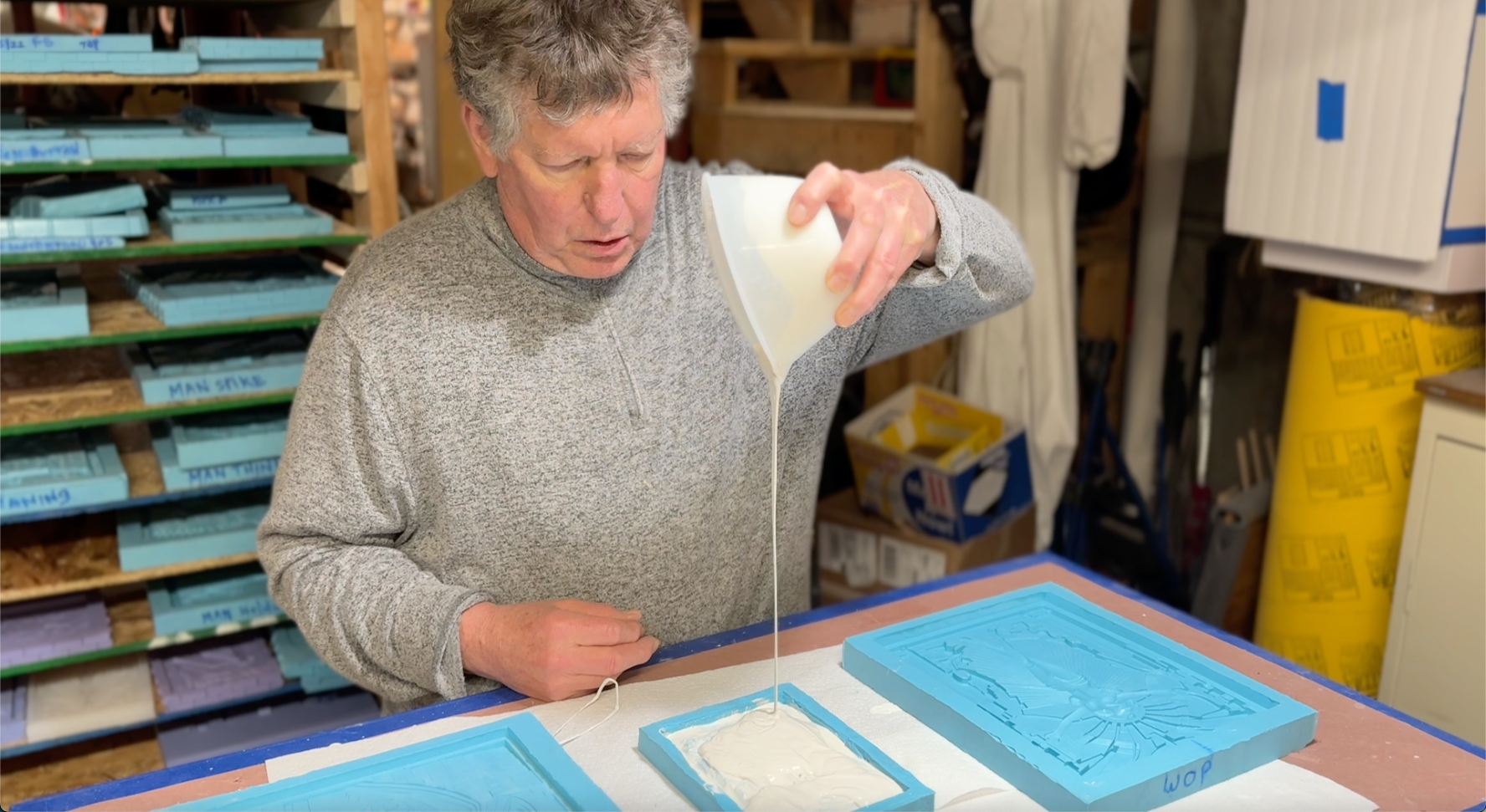
We created the master mold in silicone from the design model and were ready to cast the first piece.
First Piece Casting
A physical first piece was cast using Hydrocal. It rendered cleanly and flawlessly.
Finishing
A period-inspired surface finish was applied—using our metallic undercoat and the subtle polished metal look of Rub-n-buff to make this reminiscent of an architectural ornament of the 1930s.
The Family’s Reaction
When I shared the finished plaque with Tony, Chambellan’s grandson, his response meant everything:
“Excellent! You brought the sketch to life.”
Later, I sent him one of the plaques as a gift.
This was more than courtesy—it was confirmation that the reconstruction honored the spirit of the original sketch and the legacy of his grandfather.
Why This Matters
This project represents something rare:
- a collaboration across nearly a century
- an act of artistic stewardship
- a respectful extension of an unfinished thought from a great Art Deco sculptor
Most Deco archival materials remain locked away or passively preserved.
This reconstruction is different.
It is active preservation—a way of letting audiences experience the creative process behind the architectural ornament of the Art Deco era.
It connects the past to the present, and the present back to the artist.
And in doing so, it keeps Chambellan’s artistic voice alive.
Next Steps
This reconstruction deepened my appreciation for Chambellan’s sculptural language. In a future post, I’ll explore his architectural works—the bronze doors, metalwork, and sculptural programs that helped define American Art Deco.
For now, Woman of the Sea stands as a tribute:
- to Chambellan’s creativity
- to the survival of his sketchbook
- and to the privilege of bringing a lost Art Deco design to life